A Long Edition Original · Explainer
What Were the Hanging Gardens?
History · Engineering · Literature · World History
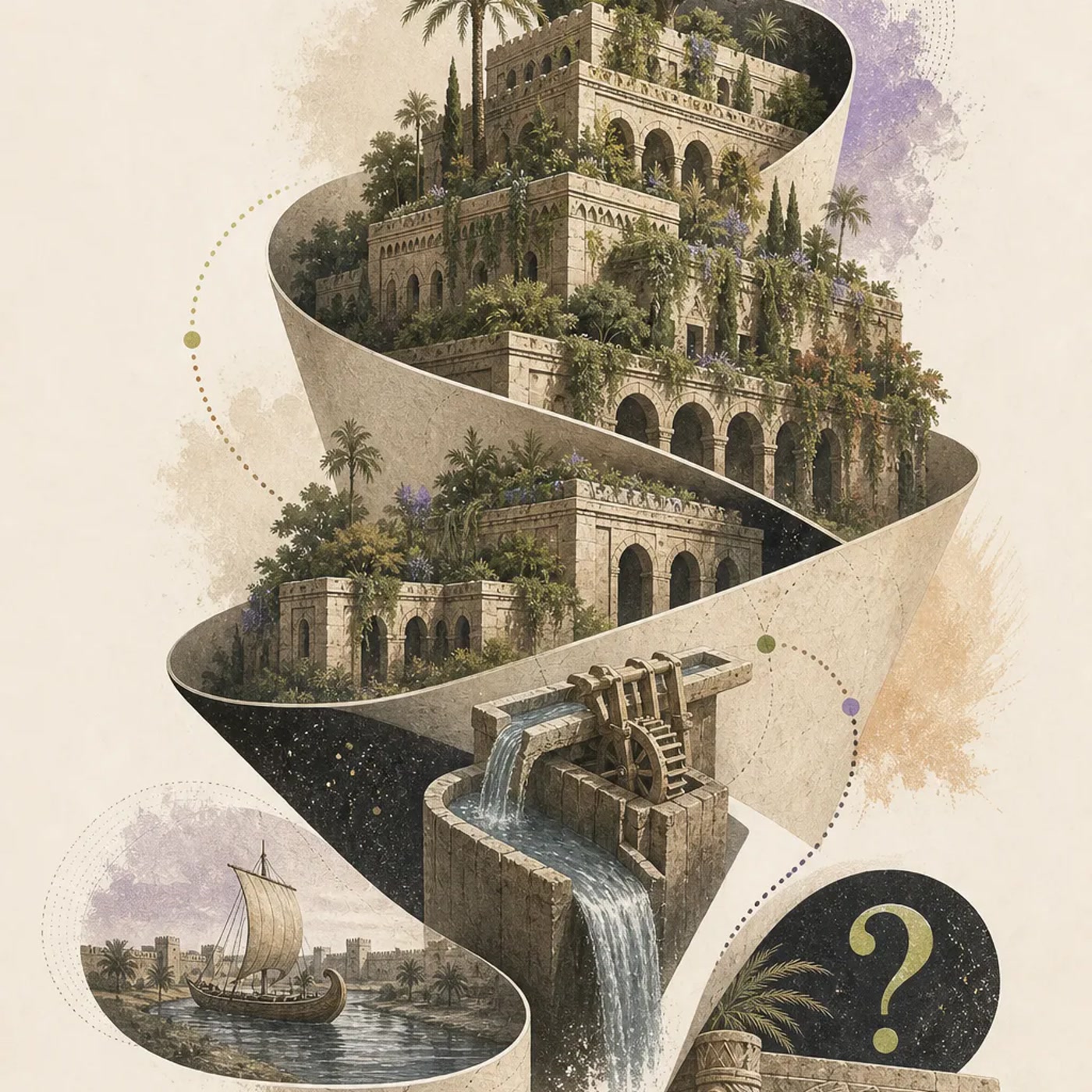
A garden built upwards: later ancient writers describe terraces and galleries carrying deep soil and large trees, supplied by lifted river water. Their accounts offer a vivid physical picture, while the identification at Babylon—or possibly Nineveh—remains unresolved.
- Duration
- 05:23
- Structure
- 4 chapters
- Voice
- Tabitha
- Evidence
- 6 sources
Listen
The complete programme.
A garden built upwards: later ancient writers describe terraces and galleries carrying deep soil and large trees, supplied by lifted river water. Their accounts offer a vivid physical picture, while the identification at Babylon—or possibly Nineveh—remains unresolved.
You’re listening to a Long Edition Original. This programme was created using an AI-assisted research and editorial process and is performed with a licensed synthetic voice. The transcript and sources are available at Long Edition dot com.
Read along
The spoken words, with silent citations.
Citation numbers are retained for reading and are not spoken in the programme.
1. A garden built upwards
How do you put a large tree above ground level—and give its roots somewhere to go?
That question gets us closer to the Hanging Gardens of Babylon than the idea of greenery dangling in mid-air. They are thought to have been an elevated royal garden: a built structure carrying deep soil and trees on rising levels, with river water lifted to the planting. [1] [2] [3]
Our clearest descriptions come from later ancient writers, including Diodorus and Strabo. These are accounts of a reported wonder, not a confirmed architectural plan. [1] [2] [3]
But they give us something quite concrete to picture. In Diodorus’s description, the approach rises like a hillside, and the structure climbs tier upon tier. The hillside, in other words, is built. The garden’s ground has itself become a work of architecture. [1]
2. Making ground for trees
Follow Diodorus’s account from the structure upwards. Beneath the planting are supporting galleries. Their task is to carry the weight of the garden above them. Above those supports lies earth, piled deeply enough, he says, for the roots of the largest trees. [1]
That depth changes the picture. We are not looking merely at leaves trailing over a balcony. The account asks us to imagine whole trees growing in a substantial body of soil, with a building underneath doing the work that solid ground would ordinarily do. [1]
A modern roof garden offers a starting point for the imagination. Now picture the planted ground rising through successive levels rather than occupying a single flat roof.
Strabo describes his version as vaulted terraces raised one above another. He too includes hollow, earth-filled supports accommodating large trees. His architectural details differ from Diodorus’s, but both put substantial planting above supporting structures. [1] [2]
This is the useful way to understand the familiar word ‘hanging’ here: a garden raised above ground, with roots held in earth rather than suspended in the air. [1] [2]
3. Lifting the river
Once the trees are up there, another question follows. How does water reach them?
Both writers include water-lifting in their descriptions. Diodorus places machinery within the structure, concealed from people outside, raising water from the river to the garden. In his account, the visible planting has a less visible counterpart: equipment supplying it with water. [1] [2]
Strabo names the river as the Euphrates. He describes stairs for the ascent, with water engines beside them, continually operated by people assigned to the task. His description brings the garden into motion. There is the structure carrying the earth, but also ongoing work bringing water up to it. [2]
The precise design of those engines remains uncertain. What the accounts give us clearly is the journey: from river level upwards into the planted garden. [1] [2]
Support and water belong together in this picture. The galleries and terraces make room for roots above ground; the lifting machinery supplies the planting there. The wonder is a garden sustained on a building. [1] [2]
4. A picture without a confirmed address
Where, then, was this garden?
Babylon is a genuine ancient attribution: Strabo includes it in his description of the city. Yet neither proposed excavated remains nor contemporary Babylonian records have produced a convincing identification. That leaves the location unconfirmed; it does not establish that no such garden existed there. [2] [3] [6]
There is a revealing comparison at Nineveh. In a contemporary royal inscription, the Assyrian king Sennacherib records planting a botanical garden beside his palace. He describes aromatic plants, fruit trees and other trees, and presents the garden as a replica of Mount Amanus. Here, too, royal gardening involved recreating a landscape. [4]
The inscription also records water channelled into gardens through feeder canals. A separate inscription at Jerwan records an aqueduct carrying water over deep valleys towards the plain of Nineveh. [4] [5]
These records make Nineveh a serious candidate for the source of the later tradition: it had a royal garden and ambitious water engineering. They do not, however, identify that garden as the Hanging Gardens or establish the elevated irrigation arrangement described by the later writers. Archaeologist Timothy Potts also highlights the proposal’s central difficulty: explaining why those writers repeatedly placed the wonder at Babylon. [1] [2] [4] [5] [6]
The location remains open. The physical idea is clearer: the Hanging Gardens were thought to be a landscape built upwards, with architecture beneath its roots and river water raised to sustain its trees. [1] [2] [3] [6]
The retained evidence
Sources behind this edition.
Library of History, Book II, chapter 10
LacusCurtius, University of Chicago
This is a university-hosted digital presentation of Diodorus’s surviving account. It is direct evidence for what Diodorus reported about the structure, planting and water supply of the named garden.
Geography, Book XVI, chapter 1, section 5
Perseus Digital Library, Tufts University
This university-hosted classical text preserves Strabo’s passage locating the garden in Babylon and describing superimposed terraces, earth for large trees and water raised from the Euphrates.
The Hanging Gardens of Nineveh
IRAQ / Cambridge University Press for the British Institute for the Study of Iraq
A research article in the peer-reviewed journal IRAQ. Its accessible extract directly assesses the evidential problem at Babylon and dates and characterises the main surviving literary tradition.
Sennacherib 138 (Q003943): royal inscription from Kuyunjik, Nineveh
ORACC, Royal Inscriptions of the Neo-Assyrian Period Project
A scholarly cuneiform edition and translation of a Neo-Assyrian royal inscription. It directly records Sennacherib’s claim to have planted a botanical garden beside his palace and channelled water into gardens at Nineveh.
Sennacherib 226 (Q004031): Jerwan Aqueduct royal inscription
ORACC, Royal Inscriptions of the Neo-Assyrian Period Project
A scholarly edition and translation of Sennacherib’s inscription on blocks from the Jerwan Aqueduct. It directly records a canal to the plain of Nineveh and an aqueduct of white limestone crossing deep wadis.
Looking for the Hanging Gardens
The New York Review of Books
A detailed interpretative review by Near Eastern archaeologist Timothy Potts. It compares the Babylonian archaeological problem with the evidence and arguments advanced for Sennacherib’s Nineveh garden, while explicitly testing the proposed transfer of the tradition.
Your subject. Properly pursued.
What would you like Long Edition to explore?
Begin with an ordinary question. Long Edition will research it, shape it and turn it into a programme made for listening.
Create your account