A Long Edition Original · Explainer
Nitrates, Nitrites and Meat: What Is the Cancer Link?
Science & Technology · Biology · Medicine
Why curing agents help preserve meat, how nitrite chemistry raises a cancer concern, and why the established finding about processed meat does not yet explain rising bowel-cancer rates in younger adults.
- Duration
- 05:36
- Structure
- 4 chapters
- Voice
- Elspeth
- Evidence
- 6 sources
Listen
The complete programme.
Why curing agents help preserve meat, how nitrite chemistry raises a cancer concern, and why the established finding about processed meat does not yet explain rising bowel-cancer rates in younger adults.
You’re listening to a Long Edition Original. This programme was created using an AI-assisted research and editorial process and is performed with a licensed synthetic voice. The transcript and sources are available at Long Edition dot com.
Read along
The spoken words, with silent citations.
Citation numbers are retained for reading and are not spoken in the programme.
1. Why put them in meat?
Why add something to meat that might raise a cancer concern? With nitrates and nitrites, the answer starts with preservation: they help control harmful bacteria, as well as giving cured meat its characteristic colour and flavour. [1] [4]
The cancer concern deserves attention. The World Health Organization concludes that eating processed meat causes bowel cancer. What remains unresolved is how much of that effect comes from these particular additives. [2] [3] [5]
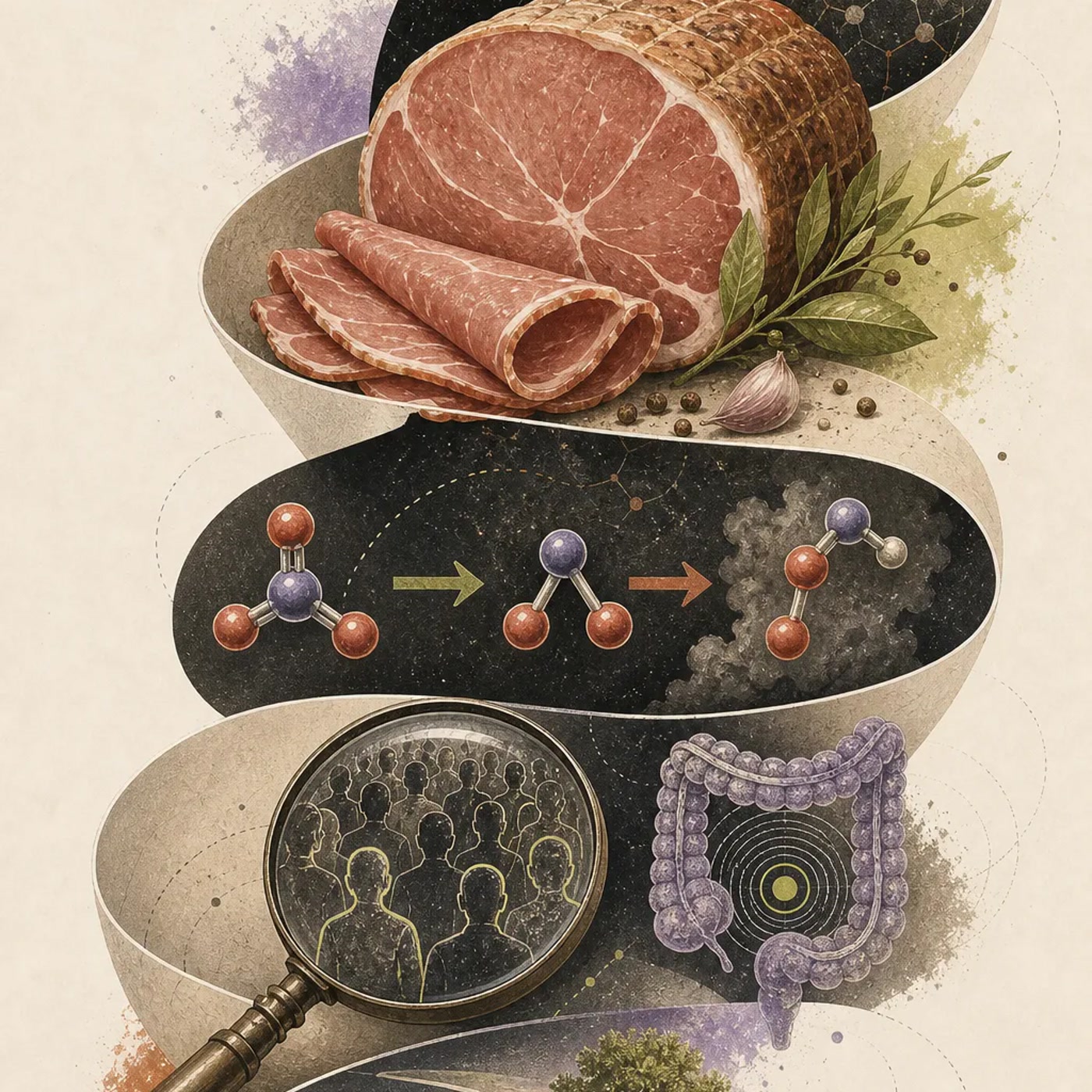
Take ham. Nitrate and nitrite salts help maintain its familiar pink-red colour and enhance cured flavour. They also hinder microbial growth, including bacteria associated with botulism. Their job is not merely cosmetic. [1] [4]
That protective role explains why reducing them requires more than changing an ingredient list. France’s food-safety agency, ANSES, recommends reducing additions as far as reasonably achievable while maintaining microbial safety. For cooked ham, one option it identifies is an earlier use-by date. For dry-cured ham, it points to strict control of salt and temperature. [4]
These are product-specific changes to the preservation system. The useful question is how to reduce the chemical concern while keeping control of dangerous bacteria. [1] [4]
2. Where the chemistry leads
First, nitrate and nitrite are related compounds, not two names for the same thing. Nitrate can become nitrite. One place this happens is in the mouth, where bacteria convert some nitrate carried in saliva into nitrite. [1]
Nitrite is central to the chemical concern. During food processing, it can react with substances called amines to form compounds called nitrosamines. Some nitrosamines are carcinogenic. Heat treatment can increase their levels, especially in meat and fish. [2]
So there is a credible chemical reason for concern. The same ingredient used within a preservation system can also participate in reactions that produce harmful compounds. [1] [2]
But those reactions depend on conditions. Knowing that they can happen does not tell us how much of processed meat’s bowel-cancer effect they explain. For that, we need to connect the chemistry with evidence about what people eat and what happens to their health. [2] [3]
3. What the human evidence says
Processed meat covers more than meat cured with these additives. The category includes meat preserved or transformed by salting, fermentation, smoking and other processes, as well as curing. That breadth matters: evidence that eating processed meat causes bowel cancer does not isolate one ingredient as the cause. [3]
A Swedish study published in August 2026 brings the question closer to the individual compounds. It followed more than eighty-two thousand middle-aged and older adults. Nitrate intake showed no association with bowel cancer. Higher nitrite intake was associated with bowel cancer in men, but not in women. [5]
That mixed result gives a reason to keep investigating nitrite, rather than treating nitrate and nitrite as a single exposure. It does not establish causation: this was an observational study, and its intake estimates included food and drinking water, not just additives in cured meat. [5]
The distinction is important for interpreting the news. Uncertainty about which components account for the effect does not undo the established finding about processed meat itself. [3]
4. Does this explain the rise in younger adults?
What, then, about younger people? An international analysis found rising bowel-cancer incidence among people aged twenty-five to forty-nine in twenty-seven of fifty countries and territories, including England, during the latest decade examined. Its diagnosis records generally extended through 2017. [6]
That establishes a widespread trend, not its cause. The analysis followed cancer diagnoses, not people’s nitrate, nitrite or processed-meat intake. And the Swedish study concerned an older population. [5] [6]
Explaining a rise requires more than identifying something that can cause cancer. It requires evidence connecting the exposure to the changing pattern of disease in the people affected. [5] [6]
The current answer is therefore clear in one respect and open in another. Processed meat is an established bowel-cancer risk, and nitrite chemistry gives a plausible reason to investigate the additives. But nitrates and nitrites have not been established as the explanation for rising rates in younger adults. [1] [2] [3] [5] [6]
The retained evidence
Sources behind this edition.
EFSA confirms safe levels for nitrites and nitrates added to food
European Food Safety Authority
EFSA is the European Union's independent food-safety risk-assessment body. This page summarises its scientific re-evaluation of authorised nitrate and nitrite food additives, including their uses, exposure assessment and stated research gaps.
Risk assessment of N-nitrosamines in food
EFSA Journal / European Food Safety Authority
A formal EFSA scientific opinion, requested by the European Commission, assessing occurrence, exposure and health concern for ten carcinogenic N-nitrosamines in food.
Carcinogenicity of red and processed meat
World Health Organization
WHO's current public explanation of the IARC evaluation provides the definition of processed meat and the established conclusion on colorectal cancer, including the distinction between hazard classification and exposure-specific risk.
ANSES Revised Opinion on the risks associated with the consumption of nitrites and nitrates
French Agency for Food, Environmental and Occupational Health & Safety
ANSES is France's statutory expert agency for food, environmental and occupational health. Its report assesses exposure, microbial-safety functions, formation of harmful compounds and options for reducing intentional additions.
Nitrate and nitrite intake and risk of colorectal cancer: a population-based cohort study
JNCI: Journal of the National Cancer Institute / Oxford University Press
A peer-reviewed prospective analysis of 82,009 Swedish adults, using repeated diet data, drinking-water estimates and national cancer-registry follow-up over approximately 25 years.
Colorectal cancer incidence trends in younger versus older adults: an analysis of population-based cancer registry data
The Lancet Oncology
A peer-reviewed international analysis using high-quality population-based registry data to compare incidence trends at ages 25–49 and 50–74 across 50 countries and territories.
Your subject. Properly pursued.
What would you like Long Edition to explore?
Begin with an ordinary question. Long Edition will research it, shape it and turn it into a programme made for listening.
Create your account